
Product Strategy · Behavioral Design · 0→1Designing a Behavior Reinforcement System for Insurance
From contained experiment to core product: R$5.5M+ returned to users, and an insurance app people come back to.
Overview
Insurance is experienced only at moments of friction — purchase, renewal, claims. Justos priced on driving behavior through telematics, but customers couldn't feel it: discounts moved slowly and invisibly.
I led Justos Rewards from problem framing and research through MVP, staged rollout, and its first iterations — partnering with another designer and engineering throughout. As Rewards matured into a core product, I handed the day-to-day to a dedicated squad.
The framing decision came first and shaped everything: not "build a rewards program" but change the relationship between insurer and customer. Retention, referrals, and engagement were expected consequences of real behavior change.
❋ RoleDesign & Product for MVP launch
❋ TeamAnother designer, Engineering
❋ TimelineMVP → staged rollout → 2+ years of iteration
R$5.5M+ (~US$1M) returned to users, 35% engagement, 12% MoM referral-driven growth
❋ ImpactDetails & Design Approach
Rewards was designed as a behavior reinforcement system, not a loyalty feature. The core challenge was translating abstract driving data into something that felt visible, fair, and worth engaging with daily.
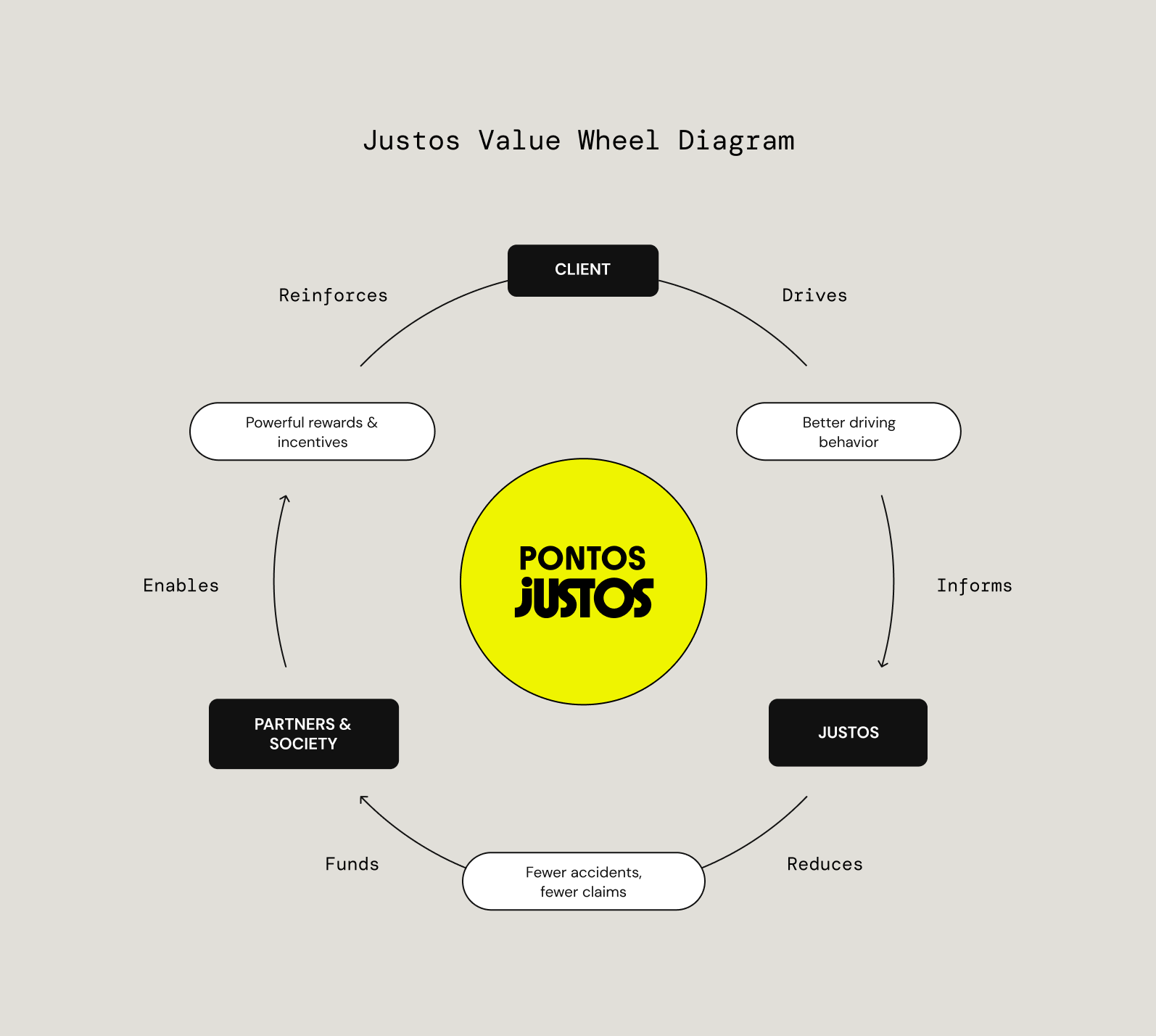
Every decision in Rewards traces one loop: client drives → behavior informs Justos's pricing → that reduces accidents and claims → savings fund Partners & Society → funding enables real rewards → rewards reinforce the client.
We rewarded not driving: When users didn’t drive, they still earned a fixed portion of the daily maximum. From an insurance perspective, not driving means less risk — so the safest behavior should be recognized, not penalized.
Averaging, not penalizing: When users drove multiple trips in a day, all were aggregated and averaged — preventing a single bad trip from wiping out a good day. The system was designed to feel fair even when the underlying telematics data was imperfect.
The mechanism: a flywheel, not a loyalty program
Frequency of value & points delivery
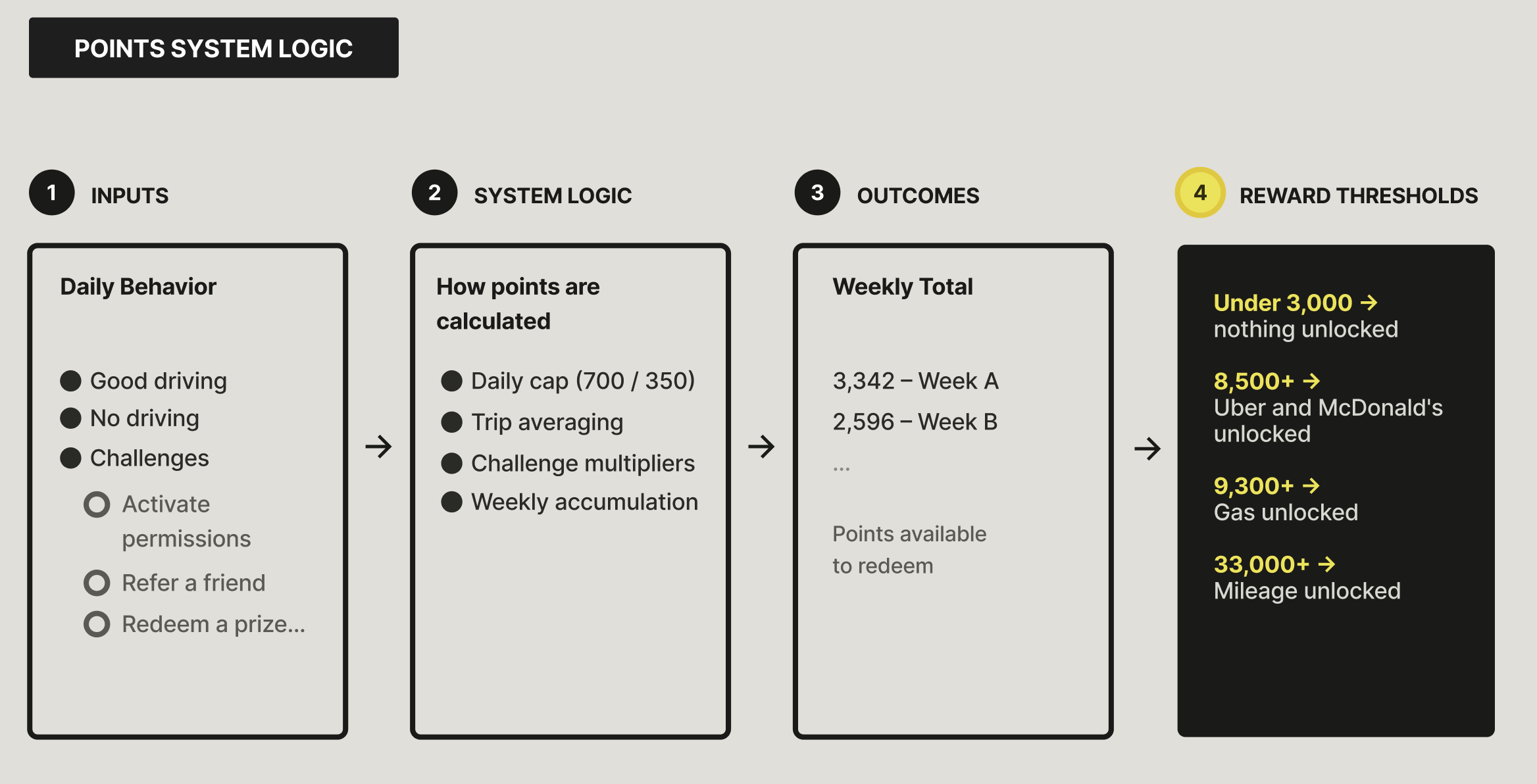
We chose a points-based model because it was the most intuitive framework — familiar from airline miles programs — and it could unify multiple inputs (driving quality, engagement actions, challenges, referrals) into a single understandable metric.
The frequency of points delivery was a central design decision. We considered three approaches:
Monthly points: Too slow — users wouldn’t perceive value for weeks, and the connection between behavior and reward would feel abstract.
Daily points only: Frequent but no excitement — receiving 500 points daily becomes background noise.
Daily accumulation with weekly payout: Users see daily progress (building anticipation), then receive a satisfying weekly total. 3,400 points landing at once creates a moment that 500 daily don't.
Learning & adapting after launch
We launched with a daily cap of 7,000 points. Post-launch, we observed that cumulative numbers were growing too large and losing psychological meaning, so we reduced by a digit. A small adjustment, but it shows how we continuously tuned the system’s “feel,” not just its function.
Our time to redeem can be as quick as 7 days.
End-to-end service design
Internal backoffice tools were updated so CX teams had full visibility into points and redemptions. If a user called support with a question about their rewards, the agent could explain it with confidence. Trust is built at every touchpoint, not just in the app.
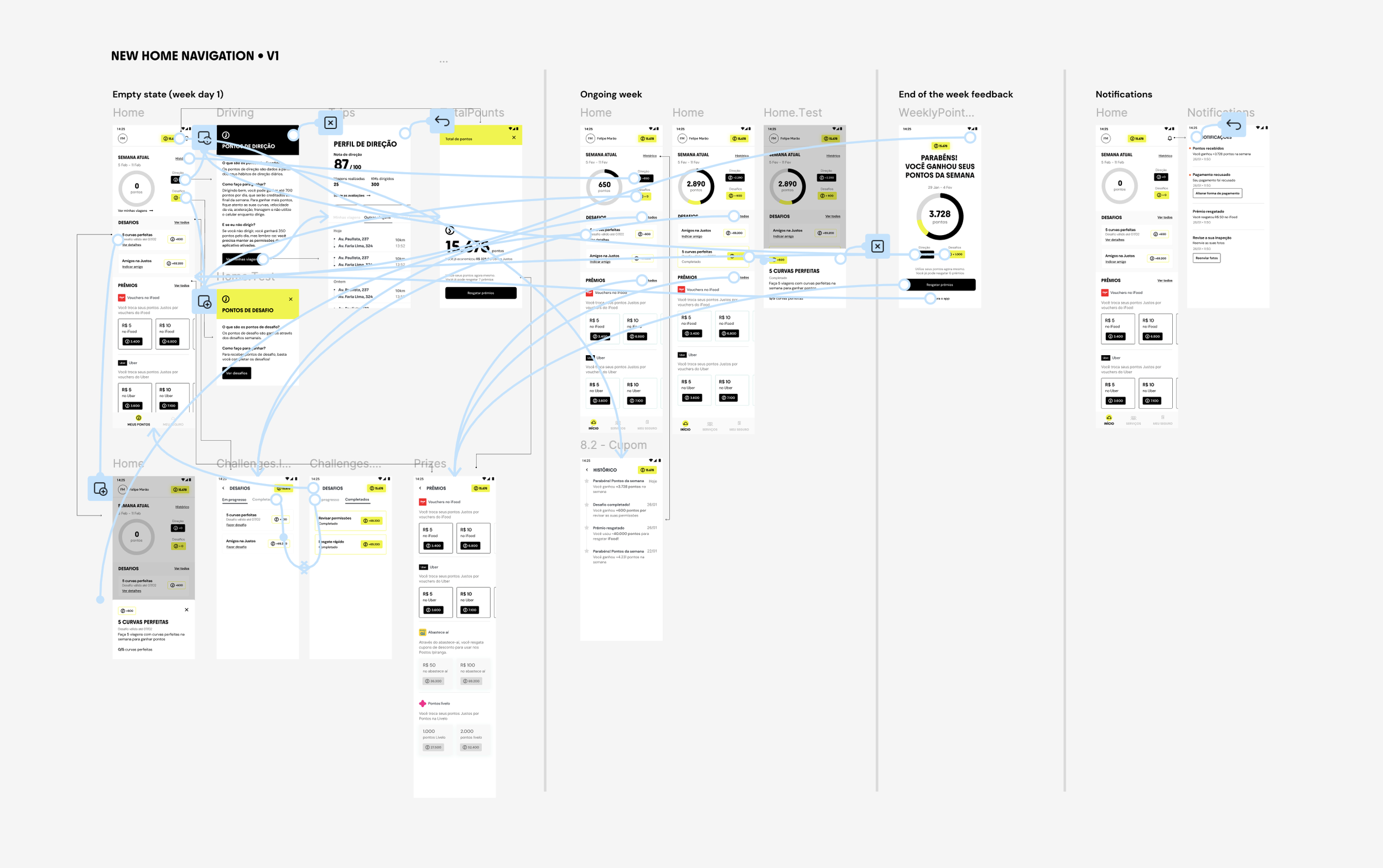
The app experience
1. Pre-driving test
Shown before the driving test (mandatory to become a policyholder) begins, introducing Rewards and setting expectations around benefits.
2. During driving test
While doing the test, users already earn points. Rewards are visible but locked until they become policyholders.
3. Post-conversion
Once insured, users see weekly progress, earn points and do challenges, reinforcing ongoing engagement.
Non-client experience, seeing points and being able to refer friends.
Prod app recording
Client experience exploring the app and redeeming points.
Staging app recording
Outcomes
R$5.5M+ (~US$1M) returned to users since launch
35% user engagement with the rewards program — in a product category most people interact with twice a year.
35% have redeemed; 16% actively engaged across rolling 8-week windows
12% MoM growth in new users from referrals in Year 2
Engagement percentages fell from the launch-era 35% — but not from program decay.
Two forces: the base scaled from under 2,000 to ~33,500, and sales flipped from D2C to broker-sold, so for 80% of today's members the rewards story arrives secondhand. The cohorts prove it: ~63% of directly-acquired users have redeemed, versus 28% of broker-acquired. The design performs when it reaches people directly, so we understand there is a gap in broker education, and that's the program's next chapter.
Meanwhile, the absolute numbers kept setting records after I handed the program off, so I can say I'm proud of the work done as the system still sustains itself.
The honest picture
63% of directly-acquired users have redeemed, versus 28% of broker-acquired.
The eligible base scaled steadily while redemptions tracked product investment cycles.
Redemptions track closely with product investment, while overall engagement remains resilient over time
System health
Points accumulation was designed to be automatic — no opt-in, no extra effort — so that every policyholder experiences the system from day one. 97% of our clientes accumulate enough points to redeem. The real engagement signal is what users choose to do: 35% have redeemed at least once, and 16% remain actively engaged over rolling 8-week windows.
High participation and eligibility rates indicate strong system comprehension and perceived fairness.
Reflection
The hardest decisions were about aligning incentives, sequencing what not to build, and killing a feature that worked technically but failed emotionally. What I'd do differently isn't fighting the deprioritization — the regulatory work that took precedence was existential, and without a licensed company there is no rewards program. It would be trying to negotiate a floor: at least one experiment per quarter, so the system never went completely untouched. Big bets can wait their turn; letting a behavior program go fully static costs more momentum than the data shows in the moment.